
SUMMARY
A battery recycling plant turns spent lithium-ion batteries and production scrap into recoverable streams: black mass, copper and aluminum foils, steel casings and plastics. The process flow typically runs through safe discharge, shredding under controlled conditions, drying, mechanical separation and, where required, thermal treatment, leaching and solvent extraction (SX), the step that separates lithium, nickel, cobalt and manganese into individual high-purity products. This article explains each stage and the equipment used in it, with a closer look at solvent extraction.
1. Why Plant Design Starts with the Feed
No two battery recycling plants are identical, because the feed defines the process. Electric vehicle packs, consumer cells, power tool batteries and gigafactory production scrap differ in format, chemistry, state of charge and contamination. Cathode chemistries such as NMC, NCA, LCO and LFP also change which metals are worth recovering and which downstream route makes economic sense.
Before selecting equipment, a plant designer should define:
- Battery formats (pouch, prismatic, cylindrical, modules or full packs)
- Dominant cathode chemistries and their expected share over time
- Target throughput and operating hours
- Target products: black mass only, or refined metal salts
- Local environmental, fire safety and waste regulations
For background on chemistries, see Lithium-ion Battery (Cathode) Types and Usage Areas.
2. Overview of the Process Flow
A complete battery recycling line can be divided into two main sections: mechanical pre-treatment, which produces black mass and separated metal fractions, and chemical recovery, where leaching and solvent extraction convert black mass into battery-grade or industrial-grade compounds.
- Receiving, sorting and storage
- Discharge and pack dismantling
- Shredding under inert or controlled atmosphere
- Drying and electrolyte removal
- Pulverization and screening
- Magnetic, air and eddy current separation
- Black mass roasting (optional, route-dependent)
- Leaching and purification
- Solvent extraction (SX) to separate cobalt, nickel, manganese and lithium
- Crystallization and precipitation of metal products
- Gas, dust and wastewater treatment
3. Receiving, Sorting and Discharge
Incoming batteries are weighed, identified and sorted by chemistry and format. Damaged, swollen or leaking batteries are isolated because they carry a higher risk of thermal runaway. Storage areas need fire detection, separation distances and suitable suppression systems.
Batteries are then discharged to a safe voltage level before mechanical processing. Discharge can be done electrically, which allows part of the residual energy to be recovered, or by other methods depending on the battery type and plant design. Large packs are manually or semi-automatically dismantled into modules or cells, and cables, housings, electronics and cooling components are removed as separate streams.
4. Shredding
Shredding opens the cells and releases the active materials. Because residual charge and flammable electrolyte can still be present, shredding is carried out in a controlled environment, often with inert gas or with a process designed to limit oxygen and ignition sources. Robust cutting tools, gas monitoring and extraction are essential.
The shredded material, a mixture of electrode coatings, foils, casings, separator film and plastics, is sent to drying. See the Shredder System for equipment details.
5. Drying and Electrolyte Removal
Electrolyte solvents must be removed before further size reduction and separation. Drying under vacuum lowers the evaporation temperature, reduces fire risk and allows solvent vapors to be condensed and captured rather than released. Dry material is also easier to separate cleanly in the following stages.
Related equipment: Vacuum Dryer System.
6. Pulverization and Screening
After drying, the material is pulverized to detach the active cathode and anode coatings from the copper and aluminum foils. The goal is to liberate the fine black mass while keeping foils in larger pieces that can be separated by size.
Screening then splits the material into size fractions. The fine fraction is concentrated black mass; coarser fractions continue to metal separation. Ultrasonic screens help prevent blinding when handling very fine, cohesive powders.
Related equipment: Pulverization System, Gradual Sieving Unit and Ultrasonic Sieving Unit.
7. Mechanical Separation of Metals and Plastics
The coarse fractions are separated using a combination of methods based on different physical properties:
- Magnetic separation removes steel casings and other ferrous parts.
- Air separation (for example zigzag classifiers) separates light materials such as separator film and plastics from heavier metal pieces.
- Eddy current separation separates non-ferrous metals such as aluminum and copper from non-metallic material.
Each saleable fraction adds value to the plant, and clean separation also improves black mass quality by reducing copper and aluminum carry-over into the chemical stage.
Related equipment: Magnetic Separation Unit, ZigZag Air Separation System and Eddy Current Separation Unit.
8. Black Mass Roasting (Pyrolysis)
Depending on the downstream route, black mass or shredded material may be thermally treated. Pyrolysis decomposes the binder (commonly PVDF) and residual organics, which improves the liberation of active material and can make subsequent leaching more effective. Off-gases from this step, including fluorine-containing compounds, require dedicated treatment.
Related equipment: Black Mass Roasting System (Pyrolysis). For thermal routes more broadly, see Metal Recovery Through Pyrometallurgical Methods.
9. Leaching and Purification
Black mass is the input for chemical recovery. In agitated leaching tanks it is dissolved in an acid solution, usually with a reducing agent, so that lithium, nickel, cobalt and manganese pass into solution. Graphite and other insoluble residues are separated with a filter press.
Before metal separation, most of the copper, iron and aluminum is removed from the leach solution, commonly by pH adjustment and precipitation. The result is a clarified pregnant leach solution (PLS) that is ready for solvent extraction.
Related equipment: Chemical Leaching System.
10. Solvent Extraction (SX): The Heart of Metal Recovery
Leaching puts all of the valuable metals into one solution. Solvent extraction is the step that separates them from each other. It is what turns black mass into individual, high-purity products such as cobalt sulfate, nickel sulfate, manganese sulfate and lithium salts, instead of a lower-value mixed product. For this reason, SX is the stage that defines product quality and, ultimately, the revenue of a hydrometallurgical battery recycling plant.
How Solvent Extraction Works
SX is a liquid–liquid separation. The aqueous leach solution is mixed with an organic phase containing an extractant that selectively binds a target metal at a given pH. After mixing, the two phases separate by gravity: the target metal moves into the organic phase, while the other metals stay in the aqueous phase, called the raffinate. Each SX circuit works in three steps:
- Extraction: the target metal is loaded from the aqueous solution into the organic phase.
- Scrubbing: co-extracted impurities are washed out of the loaded organic to raise product purity.
- Stripping: the metal is released from the organic into a clean, concentrated solution, and the organic is returned to extraction for reuse.
Several mixer-settler stages are connected in counter-current flow, so recovery and purity increase stage by stage.

A Typical SX Sequence in Battery Recycling
The exact circuit depends on the battery chemistry and the target products. NMC and NCA black mass is commonly processed in a sequence like this:
- Impurity removal: remaining impurities such as copper, iron, aluminum and zinc, and in some flowsheets manganese, are extracted first.
- Cobalt–nickel separation: cobalt is selectively extracted and separated from nickel. This is one of the most demanding separations in the process.
- Nickel recovery: nickel is extracted and stripped into a concentrated nickel sulfate solution.
- Lithium recovery: lithium stays in the final raffinate and is recovered by precipitation as lithium carbonate, or converted to lithium hydroxide.
Organophosphorus extractants such as D2EHPA and Cyanex 272 are widely used in these circuits. The pH set in each stage determines which metal is extracted.
What Makes an SX Plant Perform
- pH control: selectivity depends on pH, so stable, automatic pH control in every stage is essential.
- Organic/aqueous (O/A) ratio: the ratio must be held constant to keep loading and recovery on target.
- Mixing and phase separation: mixing must be intense enough for mass transfer but controlled enough to avoid stable emulsions, and settlers must give clean phase disengagement.
- Solvent losses: organic carried over into the aqueous phase raises operating cost and must be minimized.
- Automation: SX reacts quickly to process changes, so pH, temperature, flow and levels need continuous monitoring.
Proses Makina Solvent Extraction Systems
Solvent extraction is one of Proses Makina’s core areas of expertise. Our systems use a proprietary mixer-settler design with a specially engineered impeller for efficient metal loading and phase mixing, and an integrated solvent recovery unit that stabilizes phase ratios and reduces solvent losses. Automatic pH, O/A ratio and level control, online monitoring and PLC/SCADA integration keep every stage stable. Systems are available from 250 L/h to 10,000 L/h feed capacity, with the number of stages designed for the specific metals and purity targets.
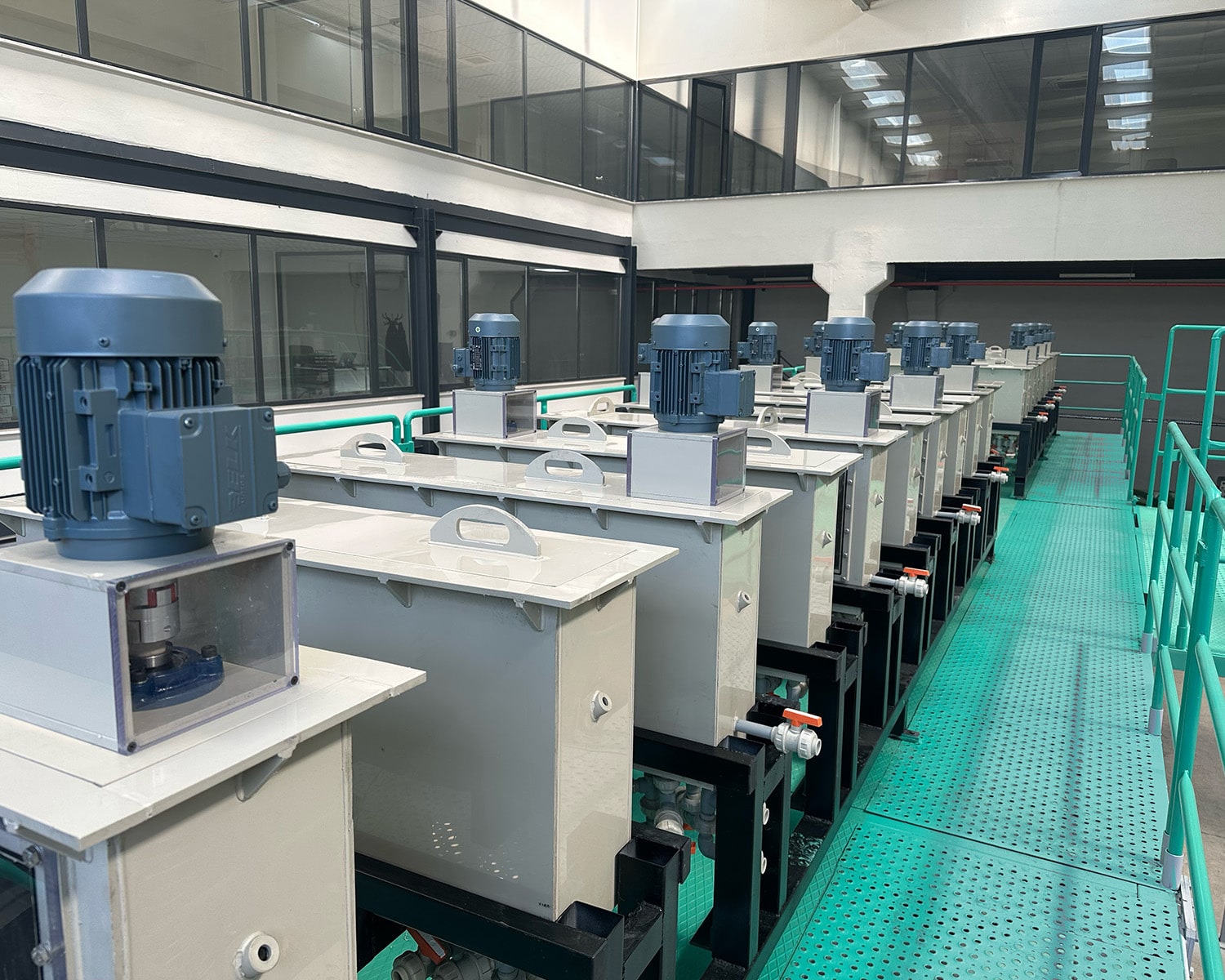
Related equipment: Solvent Extraction System.
11. Crystallization and Precipitation of Final Products
The concentrated strip solutions from SX are converted into saleable products by crystallization or precipitation, for example nickel, cobalt and manganese sulfate crystals, and lithium carbonate precipitated from the raffinate. Precipitation tanks designed for the target particle size, pH and temperature help achieve consistent product quality and easy filtration.
Related equipment: Precipitation Tank.
12. Environmental Control Systems
Environmental systems are not auxiliary equipment in a battery recycling plant; they are part of the process. Three streams need to be controlled:
- Dust: Fine black mass is hazardous and valuable. Dust collection protects workers and returns recovered powder to the product stream.
- Off-gas: Solvent vapors from drying and gases from thermal treatment must be captured and treated before release.
- Waste acid and wastewater: Spent solutions from leaching and purification are neutralized and treated so that water can be reused or discharged within limits.
Related equipment: Dust Collector System, Waste Gas Treatment Unit and Waste Acid Treatment System.
13. Key Design Considerations
- Safety: Thermal runaway risk exists from receiving through shredding. Gas detection, inerting, fire suppression and emergency procedures must be designed in from the start.
- Modularity: Many operators start with mechanical pre-treatment and sell black mass, then add hydrometallurgy later. A layout that leaves room for expansion reduces future cost.
- Chemistry flexibility: Feed mixes change over time, for example with the growing share of LFP. The plant should tolerate variation in feed chemistry.
- Product quality: Buyers price black mass on metal content and impurities. Separation efficiency directly affects revenue.
- Product targets: Whether the plant sells a mixed product or individual battery-grade salts determines the SX circuit, the number of stages and the level of automation required.
- Compliance: Permitting, transport of hazardous goods and emissions limits vary by country and should be reviewed early.
14. Conclusion
A battery recycling plant is a chain of mechanical, thermal and chemical steps, and the performance of each step depends on the one before it. Safe discharge and controlled shredding protect the plant; effective drying, pulverization and separation define black mass quality; and leaching followed by solvent extraction turns that black mass into individual, high-purity metal products. Designing the line around the actual feed and target products is the most reliable way to achieve safe operation and good recovery.
To plan a battery recycling line for your feed and capacity, explore our Battery Recycling Systems or contact our engineering team at info@proses-makina.com.